What Is A Programmatic Ad Agency And How Does It Work?
Today, advertising has become fast, data-driven, and highly competitive. Marketers require accuracy, effectiveness, and the capacity to scale across channels without wasting money. That’s where a programmatic ad agency comes into play to solve these challenges and deliver a smooth workflow and successful campaigns.
We’ll look into what programmatic advertising is, how it operates, the platforms that support it, its main advantages, and how companies like yours are using it below.
What is Programmatic Advertising?
Programmatic advertising is the automated method of buying and selling digital ad space in real time. It uses algorithms, data, and software platforms to deliver ads to the right audience at the right time, rather than through manual agreements. Basically, programmatic advertising replaces a faster, more accurate, and channel-scalable system for traditional, manual ad buying. It enables marketers to effectively target audiences while continuously improving campaign results.
How Programmatic Advertising Works
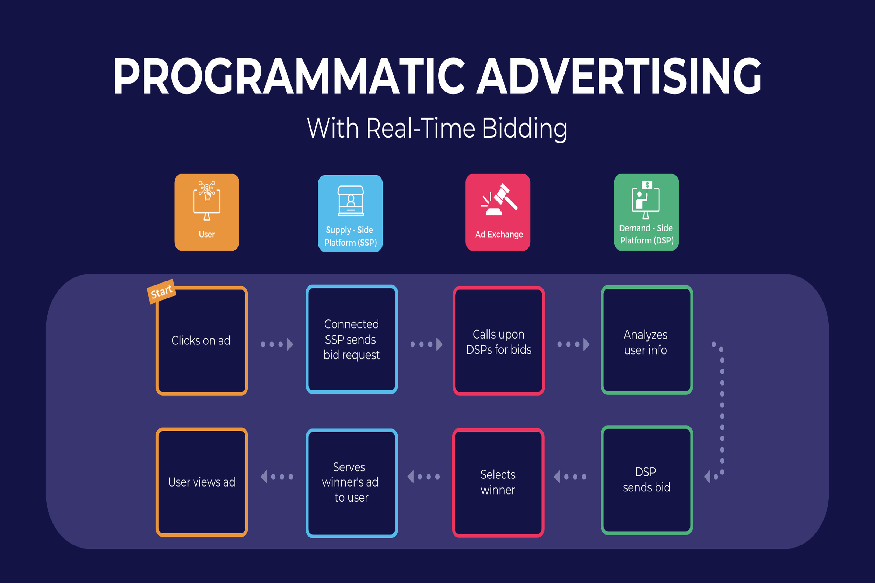
There is a quick process that goes into the definition:
- An open ad slot appears when a visitor visits a website or application.
- The slot is made available to advertisers in real time at the start of an RTB auction.
- When trying to determine a bid, demand-side platforms examine audience data, campaign objectives, and budgets. DSPs assess the potential.
- When the highest bid wins, the user is immediately shown the winning advertisement.
- Advertisers, media, and data are all connected in a single, seamless ecosystem through this immediate exchange.
Marketers use specialized platforms and technologies, which are the foundation of programmatic advertising, to make this work.
Programmatic Advertising Platforms and Tools
A networked collection of platforms that handle delivery, data, and inventory is essential to programmatic advertising. Each has a distinct function within the ecosystem:
Ad Exchange
An online marketplace where marketers place real-time bids and publishers offer their ad space.
Demand-Side Platform (DSP)
Advertisers can buy ad placements on several exchanges using this software platform. DSPs automatically manage optimization, bidding, and targeting.
Supply-Side Platform (SSP)
An ad inventory management and sales solution for publishers. By connecting to exchanges and DSPs, SSPs enable publishers to get the most out of their available impressions.
Data Management Platform (DMP)
A centralized system that gathers and arranges audience information from various sources. Advertisers may optimize targeting, create segments, and incorporate analytics into DSP campaigns with the aid of DMPs.
Ad Server
Technology for managing, storing, and distributing advertisements across channels and devices. Additionally, ad servers monitor performance and assist advertisers in real-time effectiveness assessment.
Ad Network
A middleman that links publishers with advertisements. Networks still help in the large-scale aggregation of inventory, even though they are less important in contemporary programming.
Programmatic advertising is based on these tools. However, the measurable impact—clear advantages in performance, efficiency, and targeting—is what drives brands to invest.
Benefits of Programmatic Advertising
Marketers can benefit greatly from programmatic advertising.
You may maximize the opportunity and steer clear of typical traps by being aware of both sides.
Read More: HOW TO EVALUATE A DISPLAY MARKETING AGENCY TO SCALE YOUR DIGITAL PRESENCE
Benefits
Targeted advertising
Programmatic creates exact audience groups using audience data, such as browsing habits, demographics, and previous interactions.
Advertisers can target messaging to those who are most likely to convert rather than using large-scale campaigns. In addition to increasing relevance, this helps cut down on wasteful spending on impressions that don’t support marketing objectives.
Real-time optimization
Programmatic campaigns are dynamic, in contrast to traditional media purchases that stay the same after they are made. Based on performance signals, advertisers can rapidly modify bids, update creative, or fine-tune audience settings.
This ensures that ads adapt to changing consumer habits, market trends, or competitors.
Read More: WHAT MAKES A DIGITAL MARKETING COMPANY RESULTS-DRIVEN?
Automation
Programmatic eliminates the tedious, manual negotiations associated with traditional ad buying.